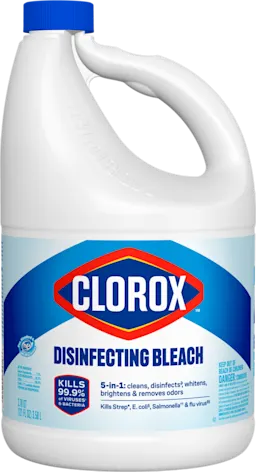
Family of Brands

Whether you're using bleach for laundry, daily clean-up or deep cleaning the toughest, messiest parts of your bathroom and kitchen, these simple guidelines can help deliver safe and effective results.
Bleach is one of the most versatile cleaning and disinfecting products available, and when used as directed, it’s safe for use, whether you're disinfecting your kitchen, sanitizing laundry or tackling mold and mildew.
Bleach is a disinfectant made primarily of sodium hypochlorite, a compound that kills 99.9% of germs including bacteria, viruses and fungi. It works by breaking down organic matter through oxidation, which is also what causes the familiar “bleach smell.” Learn more on our https://www.clorox.com/learn/what-is-bleach-what-are-active-ingredients/ page.
Bleach is safe and effective for a wide range of household tasks:
Always dilute bleach. Follow our Bleach Dilution Ratio Chart.
Ventilate your space. Open windows or use fans.
Wear gloves as directed. Especially for long cleaning sessions.
Follow label directions for best results and safety.
Do not store bleach within reach of children or pets. Keep it in a secure, ventilated space.
Do not induce vomiting if bleach is swallowed.
Do not apply ointments or creams without rinsing thoroughly first.
Do not use undiluted bleach for cleaning. Always dilute according to label instructions.
Do not mix bleach with other cleaners. Especially ammonia or vinegar — this can create toxic fumes.
Do not use bleach on non-bleach-safe surfaces and fabrics. Always check labels.
No, mixing bleach with other household cleaners — especially those containing ammonia or acids — can produce dangerous fumes. Always use bleach on its own and in a well-ventilated space.
| Do Not Mix With | Why It's Dangerous | What Could Happen |
|---|---|---|
| Ammonia | Creates chloramine gas | Coughing, chest pain, fluid in lungs |
| Vinegar | Forms chlorine gas | Eye/nose/throat irritation, breathing issues |
| Rubbing alcohol | Can create chloroform | Dizziness, nausea, unconsciousness |
| Toilet bowl cleaner | Chemical reaction varies by formula | May produce toxic fumes |
Source: 1,2,3,4
Overuse doesn’t improve performance and can damage surfaces. Use our Bleach Dilution Chart to ensure proper strength.
Rinse surfaces away from soil and water sources.
After disinfecting, rinse surfaces with clean water and direct runoff away from gardens or wildlife.
Bleach is safe when used as directed, but overexposure can cause irritation. If bleach is accidentally ingested, call Poison Control immediately. For skin or eye contact, rinse thoroughly with water.
Mix ⅓ cup of bleach with 1 gallon of cool water.
Use a cloth, mop or spray bottle to apply.
Keep surface wet for 6 minutes to disinfect.
For food-contact surfaces, rinse with potable water.
Let the surface dry naturally or wipe with a clean towel.
https://www.cdc.gov/hygiene/about/cleaning-and-disinfecting-with-bleach.html
https://www.webmd.com/a-to-z-guides/ss/slideshow-cleaning-with-bleach-harmful-mistakes-youre-making
https://corecheminc.com/cleaning-with-bleach-heres-what-you-need-to-know/
https://www.marthastewart.com/1526107/right-way-clean-bleach-your-home